Welcome to the Foundations of the Path. This page serves as an introduction to the core beliefs, values, and ideas that shape the Open Hearth Path. While every person will walk their own unique spiritual journey, these foundations act as the hearthstones upon which the Path is built.
The Open Hearth Path is centered around the belief that every person carries a sacred flame within themselves. This flame is the source of wisdom, intuition, creativity, strength, and connection to the Divine. The purpose of the Path is not to control that flame, but to nurture it, protect it, and allow it to grow.
At its heart, the Open Hearth Path is a path of personal growth, responsibility, reflection, community, and lifelong learning. It honors both the sacred and the mundane, recognizing that spirituality is not something separate from everyday life, but something woven through it.
These foundations are not meant to be strict rules or rigid commandments. Instead, they are guiding principles that help shape the spirit of the Path. They are meant to inspire thought, encourage growth, and provide a place to return to whenever you feel uncertain or disconnected.
As you continue exploring the Open Hearth Path, remember that no two journeys will look exactly alike. There is room here for different beliefs, different experiences, and different ways of practicing. What matters most is that you continue tending the flame within yourself and walking with intention.
The Hearth is open. The flame is alive. And this is where the journey begins.
The Sacred Flame
At the center of the Open Hearth Path is the belief that every person carries a sacred flame within themselves. This flame is more than a symbol. It is the living spark of spirit, wisdom, intuition, creativity, and power that exists inside each of us. It is the quiet force that calls us to grow, to heal, to create, and to become more fully ourselves.
The sacred flame is not something that must be earned. It is not given only to a chosen few. It exists within everyone, whether they realize it or not. Some people feel deeply connected to that flame, while others may feel as though life has dimmed it through hardship, fear, pain, or self-doubt. Yet no matter how hidden it may seem, the flame is never truly gone.
The Open Hearth Path teaches that one of the most important things we can do is learn to tend that inner fire. Just as a hearth fire must be cared for in order to stay alive, our spirit also requires attention and nourishment. When we ignore ourselves, silence our intuition, or lose sight of what matters to us, the flame may begin to weaken. When we care for ourselves, listen to our inner voice, seek wisdom, and live with intention, the flame grows stronger.
The sacred flame is also our connection to the Divine. It reminds us that we are not separate from the sacred, but part of it. The Divine does not only exist in distant places, ancient stories, or grand rituals. It also lives within us, in the choices we make, the love we give, the courage we show, and the way we move through the world.
There will be times when your flame burns brightly and times when it feels smaller. There will be seasons of certainty and seasons of struggle. Both are part of the journey. The goal is not to keep the flame perfect or constant, but to continue returning to it, again and again.
When you tend your sacred flame, you are tending your spirit. You are honoring your truth, your purpose, and your place within the greater web of life.
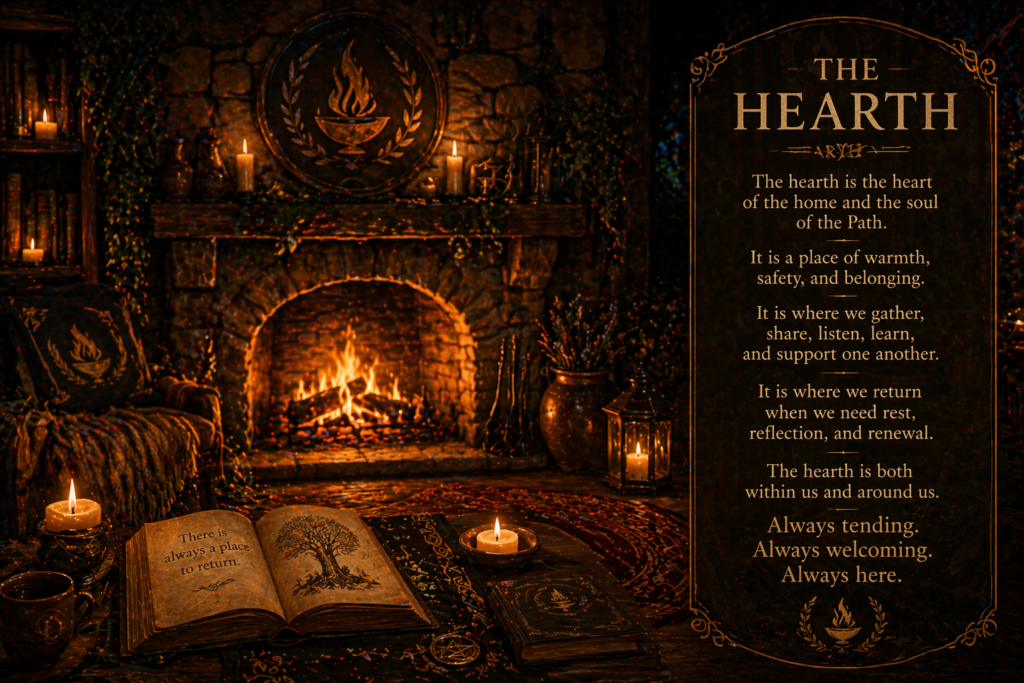
The hearth is one of the most important symbols within the Open Hearth Path. Throughout history, the hearth has been the center of the home: the place where people gathered for warmth, food, protection, conversation, and rest. It was where stories were shared, wisdom was passed down, and people came together after long days in the world. In many ways, the hearth was not only the center of the home, but the center of life itself.
Within the Open Hearth Path, the hearth represents much more than a physical fire. It symbolizes the sacred space we create within ourselves and with others. It is the place we return to when we need comfort, guidance, healing, reflection, or connection. The hearth reminds us that we all need a place where we feel safe enough to be ourselves and where we can reconnect with what truly matters.
The hearth is also a symbol of community. A fire is strongest when it is tended, shared, and protected. In the same way, people often grow stronger when they have others around them who offer support, wisdom, and encouragement. The Open Hearth Path teaches that while we each carry our own flame, we are not meant to walk entirely alone. There is value in gathering together, learning from one another, and creating spaces where everyone feels welcome.
At the same time, the hearth also exists within us. It is the inner place where we hold our memories, our values, our hopes, and our sense of belonging. It is where we return when life feels uncertain or overwhelming. Even when the world outside feels chaotic, the hearth reminds us that there is always a place within ourselves where we can rest, reflect, and begin again.
The Open Hearth Path teaches that tending the hearth is just as important as tending the flame. A fire cannot survive without a place to live, and our spirit cannot thrive without a sense of grounding, purpose, and connection. Whether you create your hearth through ritual, your home, your relationships, or your own inner world, it is something sacred and worthy of care.
The hearth is a place of welcome, wisdom, warmth, and return. No matter how far you wander, the hearth is always there waiting for you.
Personal Responsibility
The Open Hearth Path teaches that we are responsible for the lives we create, the choices we make, and the energy we bring into the world. While we cannot control everything that happens to us, we can choose how we respond, how we grow, and what kind of person we wish to become.
Personal responsibility begins with recognizing that we are the masters of our own fate. We are not powerless, nor are we meant to simply drift through life waiting for others to tell us who we are or what we should do. The Path encourages us to take ownership of our decisions, our actions, and the direction of our lives.
This also means taking responsibility for our own happiness. No one else can fully create peace, purpose, or fulfillment for us. While relationships, community, and support are important, our sense of meaning must ultimately come from within. The Open Hearth Path teaches that happiness is not something we wait for; it is something we actively nurture through the choices we make, the boundaries we set, the people we surround ourselves with, and the way we care for ourselves.
Personal responsibility also means accepting the consequences of our actions. Every choice we make has an impact, whether on ourselves, on others, or on the world around us. The Path encourages mindfulness and intention, reminding us to think carefully about how we speak, act, and move through the world.
At times, taking responsibility can be difficult. It may require us to face uncomfortable truths, admit mistakes, or let go of old habits that no longer serve us. It may ask us to stop blaming others, stop waiting for the “perfect” moment, and step into our own power. Yet it is often through these moments that the greatest growth happens.
The Open Hearth Path does not ask for perfection. It asks for honesty, accountability, and the willingness to keep learning. We will all make mistakes. We will all have moments when we fall short. What matters is not that we never stumble, but that we continue to rise, reflect, and move forward with greater wisdom than before.
When we embrace personal responsibility, we honor our sacred flame. We become active participants in our own lives rather than passive observers. We remember that while we may not control every storm, we can choose how we tend the fire within us.
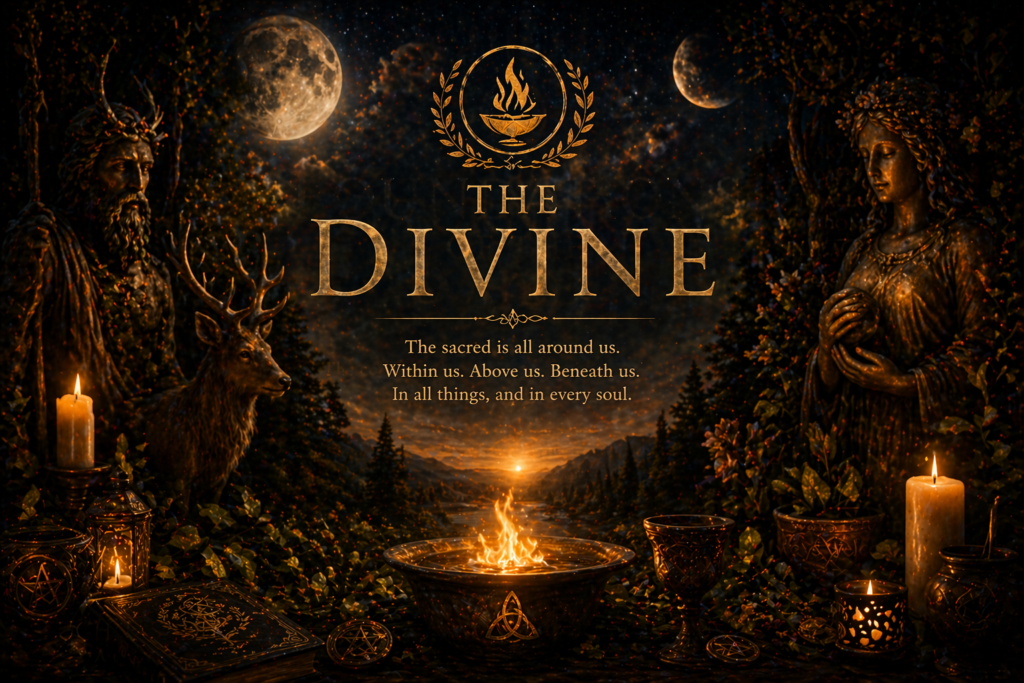
The Open Hearth Path recognizes that the Divine can be experienced in many different forms. Some may find connection through Gods and Goddesses, some through nature, ancestors, spirits, or sacred energies, and others through the quiet voice within themselves. There is no single way to understand the Divine, and no single image or name that can fully contain it.
The Path teaches that the Divine exists both around us and within us. It can be found in the turning of the seasons, the rising of the moon, the warmth of a hearth fire, the stillness of a forest, the wisdom of an elder, or the love shared between people. The sacred is woven into everyday life, waiting to be noticed in both the extraordinary and the ordinary.
The Open Hearth Path honors both masculine and feminine expressions of the Divine, while also recognizing that the sacred exists beyond human labels and categories. Some may work with specific deities, while others may simply connect with the Divine as a greater force, universal energy, or sacred presence. All approaches are welcome.
Above all else, the Open Hearth Path places strong importance on the Divine Within. It teaches that every person carries a spark of the sacred inside themselves. This does not mean that we are perfect or all-powerful, but that we each carry wisdom, intuition, creativity, and worth within us. The Divine is not only something we seek outside ourselves. It is also something we discover when we listen to our inner voice, trust our instincts, and learn to honor who we are.
This understanding of the Divine encourages both humility and empowerment. It reminds us that we are part of something greater than ourselves, while also teaching that we are not separate from it. We are connected to the earth, to one another, to those who came before us, and to the sacred flame that lives within all things.
The Open Hearth Path does not require everyone to believe the same thing about the Divine. Instead, it invites each person to explore what feels true to them, to remain open to growth and mystery, and to build a relationship with the sacred that feels meaningful and authentic.
The Divine is not distant. It is here, now, around us, and within us.
Respect for Different Paths
The Open Hearth Path teaches that there is no single correct way to connect with the sacred. Every person comes to their spiritual journey with different experiences, beliefs, questions, and needs. Some may honor Gods and Goddesses, some may work with ancestors or spirits, some may focus on nature, and others may simply seek a deeper understanding of themselves. All of these paths have value.
One of the core beliefs of the Open Hearth Path is that spiritual growth should not be built on judgment, gatekeeping, or the idea that only one person or group has all the answers. While traditions, teachings, and communities can offer guidance, no one should be made to feel lesser because their practice looks different from someone else’s.
Respect for different paths means understanding that what feels meaningful and true for one person may not feel the same for another. One person may find power in ritual and ceremony, while another may connect most deeply through quiet reflection or time in nature. One person may work closely with deities, while another may focus more on personal energy, meditation, or the cycles of the earth.
The Open Hearth Path does not ask people to abandon their individuality in order to belong. Instead, it encourages people to learn from one another, remain open-minded, and honor the many ways that people experience the Divine. Differences are not something to fear. They are opportunities for growth, understanding, and deeper connection.
Respecting different paths also means respecting boundaries. Not every person will believe the same things, practice the same way, or want the same experiences. The Path teaches that we should never force our beliefs onto others or assume that our way is the only way. True spiritual community is built through kindness, listening, and mutual respect.
This does not mean that we must agree with every belief or practice we encounter. It simply means that we approach others with curiosity instead of judgment, and with compassion instead of superiority. We can hold our own beliefs strongly while still honoring the right of others to walk their own path.
The Open Hearth Path reminds us that there are many roads leading toward wisdom, healing, and connection. No two journeys will look exactly alike, and that is part of what makes them sacred.
Solitary and Community Practice
The Open Hearth Path honors both solitary practice and community. There is no single “right” way to walk the Path, and each person may find themselves drawn to different forms of practice at different points in their life. Some people feel most connected to the sacred when they are alone in quiet reflection, while others feel most alive when gathered around the hearth with others. Both ways are valid, and both have something important to offer.
Solitary practice creates space for personal exploration, self-discovery, and a deeper connection with your own inner flame. It allows you to move at your own pace, develop your own rituals, and discover what feels meaningful to you without outside pressure or expectation. Solitary practice may include meditation, journaling, prayer, divination, candle work, spending time in nature, or simply sitting quietly with your thoughts.
There is something powerful about learning to sit with yourself and trust your own intuition. Solitary practice can teach self-reliance, personal responsibility, and confidence in your own spiritual voice. It reminds us that even when we are physically alone, we are never truly disconnected from the sacred.
At the same time, community practice offers support, connection, and shared energy. Gathering with others can create a sense of belonging and remind us that we are not alone in our journey. Community gives us people to celebrate with, learn from, and lean on during difficult times.
Community practice may include temple gatherings, rituals, seasonal celebrations, classes, study groups, discussion circles, or simply spending time with others who understand and respect your path. Group rituals often carry a different kind of energy than solitary practice. There is something powerful about many people coming together with a shared intention, supporting one another and adding their own flame to the fire.
The Open Hearth Path teaches that there is value in both solitude and connection. Solitude helps us understand ourselves, while community helps us understand our place among others. There may be seasons when you need more quiet and reflection, and there may be seasons when you need more fellowship and support. Neither is better than the other.
What matters most is finding the balance that feels right for you. The Path is not about forcing yourself into a certain way of practicing. It is about honoring your needs, listening to your intuition, and remembering that whether you walk alone, with others, or somewhere in between, the hearth remains open to you.
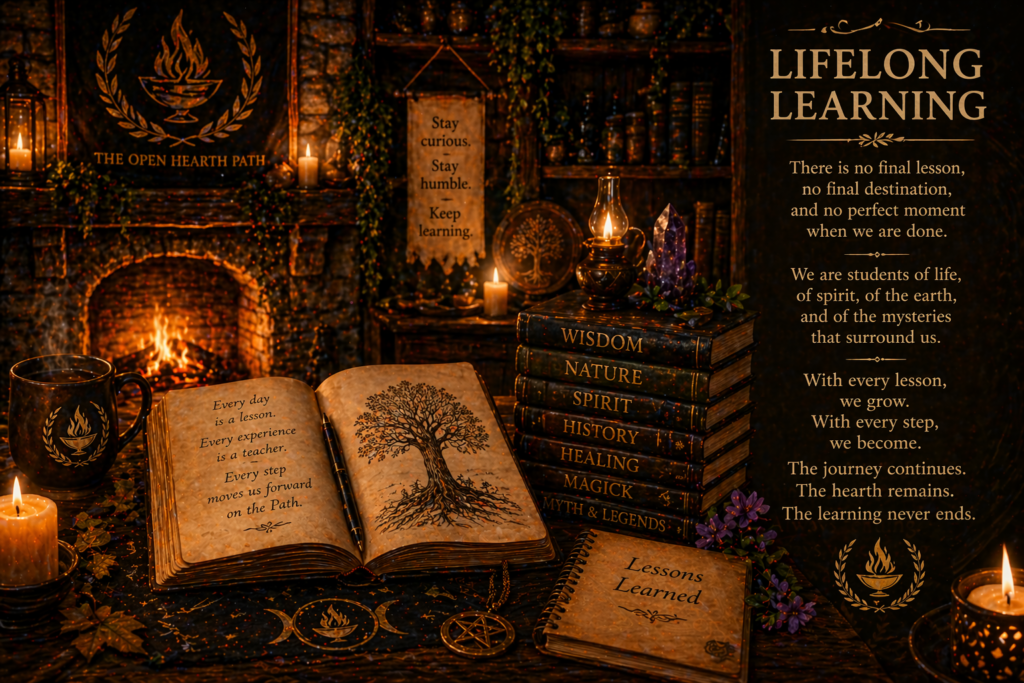
The Open Hearth Path teaches that spiritual growth is a lifelong journey. There is no final destination where a person suddenly has all the answers, masters every skill, or becomes “finished.” No matter how long you have walked the Path, there will always be more to discover, more to question, and more to learn.
Learning is not only something we do through books, classes, or formal study. It happens through experience, reflection, mistakes, conversations, rituals, seasons of change, and the simple act of living. Every success and every hardship has something to teach us if we are willing to listen.
The Open Hearth Path encourages curiosity and openness. It asks us to remain willing to explore new ideas, reconsider old beliefs, and allow ourselves to grow beyond what we once thought we knew. Sometimes the lessons we need most are the ones we least expect.
Lifelong learning also means understanding that growth is not always comfortable. There may be times when we outgrow certain beliefs, release practices that no longer resonate, or realize that we need to begin again in some area of our lives. This is not failure. It is part of the journey.
The Path teaches that wisdom is not found in pretending to know everything. True wisdom comes from humility, from being willing to ask questions, from listening to others, and from recognizing that there is always more to learn.
Every person you meet, every ritual you perform, every season you pass through, and every challenge you face can become a teacher. The world itself is full of lessons waiting to be discovered.
The Open Hearth Path is not about reaching a point where you no longer need to grow. It is about continuing to tend your flame, expand your understanding, and remain open to the endless process of becoming.
No matter where you are on your journey, there is always another lesson waiting at the hearth.
The Turning of the Wheel
The Open Hearth Path honors the cycles of nature and the turning of the seasons. Just as the earth moves through periods of growth, abundance, decline, rest, and renewal, so do we. The Wheel reminds us that life is always changing. There are seasons when we are called to build, seasons when we are called to let go, seasons when we feel full of light, and seasons when we need rest and reflection.
The Turning of the Wheel teaches that these cycles are natural and sacred. We are not meant to remain the same forever. Growth comes in waves. Some seasons of life feel bright and active, while others feel quiet and uncertain. Both are necessary. Both have wisdom to offer.
Throughout the year, the Open Hearth Path recognizes eight seasonal festivals that help mark the journey of the Wheel. Each one carries its own themes, lessons, and energy.
Samhain is a time of endings, remembrance, and honoring ancestors. It invites us to reflect on what must be released and what wisdom we carry forward into the next cycle.
Yule celebrates the return of the light during the darkest part of the year. It reminds us that even in times of darkness, hope and warmth remain.
Imbolc marks the first stirrings of spring and encourages us to begin preparing for new growth, inspiration, and possibilities.
Ostara is a season of balance, fertility, and new beginnings. It reminds us to welcome growth and fresh opportunities into our lives.
Beltane celebrates passion, creativity, abundance, and the fire of life. It is a time to embrace joy, movement, and transformation.
Litha honors the height of the sun’s strength and the fullness of life. It is a time of gratitude, vitality, and recognizing what has flourished.
Lughnasadh is the first harvest festival, a season of gratitude for the work we have done and the blessings we have received.
Mabon marks the final harvest and invites us to reflect on balance, gratitude, and preparation for the darker months ahead.
The Wheel teaches us that every season has value. Times of abundance are important, but so are times of rest. Times of celebration matter, but so do times of grief and reflection. Nothing lasts forever, and nothing remains unchanged. The Wheel continues to turn.
By honoring the cycles of the earth, we learn to honor the cycles within ourselves. We learn to trust that even when we are in a season of darkness, there will be light again. Even when we feel lost, the Wheel keeps moving, and the hearth remains waiting for us.
Living with Intention
The Open Hearth Path teaches that spirituality is not something separate from everyday life. It is not limited to rituals, holy days, altars, or special occasions. True spiritual practice is woven into the choices we make, the way we treat others, the way we care for ourselves, and the energy we bring into the world each day.
Living with intention means moving through life with awareness rather than simply reacting out of habit. It means asking yourself what truly matters, what kind of person you want to be, and whether your actions reflect the values you hold within your heart.
Intention can be found in even the smallest moments. It may be present when you light a candle in the morning, prepare a meal with care, speak kindly to someone who is struggling, spend time in nature, or take a few moments to reflect before bed. The Open Hearth Path teaches that no act is too small to be sacred when it is done with purpose and presence.
Living with intention also means taking responsibility for the energy you carry. The words you speak, the choices you make, and the way you treat yourself and others all have an impact. The Path encourages mindfulness, reminding us that what we give to the world often shapes what we receive in return.
This does not mean that you must be perfect or constantly focused on self-improvement. Life is busy, difficult, and unpredictable. There will be days when you feel disconnected, distracted, or overwhelmed. Living with intention is not about never making mistakes. It is about returning to yourself when you lose your way and continuing to choose growth, kindness, and awareness whenever you can.
The Open Hearth Path teaches that the sacred is found not only in grand rituals, but in ordinary moments. A home can become a temple. A meal can become an offering. A walk can become a meditation. A simple act of care can become an expression of love and magick.
When we live with intention, we stop drifting through life half-awake. We begin to notice the beauty around us, the lessons within us, and the quiet ways that the sacred moves through our lives every day.
Living with intention is one of the ways we keep the flame alive.